You booked the flight. You found somewhere to sleep. You figured out how to cram an unreasonable amount of shit into one backpack.
Now we need to talk about your phone.
Because apparently crossing an ocean can make something you use every waking minute suddenly require a telecommunications degree.
It doesn’t.
But there are a few things worth figuring out before you land.
First: Figure Out What Your Phone Plan Actually Does
Do this before you leave the United States.
Not at the airport.
Not while standing on a sidewalk in Nice.
And definitely not after you get a text from your carrier saying, “Welcome to France! We’ve activated your international day pass,” which sounds cheerful until you realize they’re charging you every damn day.
Check:
- Does your regular plan include international data?
- Which countries are included?
- Are calls included?
- Are texts included?
- Is there a daily international charge?
- Is there a monthly international option?
- How much high-speed data do you actually get?
Then do the math for the whole trip.
A $10 or $12 daily charge doesn’t sound terrible until you multiply it by two weeks and realize you just spent the equivalent of several excellent European dinners on the privilege of checking Facebook.
Your Other Option: An eSIM
This is one of those things that sounds considerably more complicated than it is.
An eSIM is basically a digital SIM card you can install on your phone. Instead of paying your American carrier to follow you around Europe, you buy a data package specifically for your trip.
No tiny plastic card to lose.
No hunting for a phone store after landing.
You can usually buy and install it before you ever leave home.
The important part is making sure your phone is unlocked and compatible with eSIMs.
Also pay attention to whether the plan you’re buying includes actual phone calls and SMS or is data only.
Data-only is perfectly fine for a lot of travelers because…
You Probably Don’t Need to Make Many Actual Phone Calls
Wi-Fi and mobile data handle most of what I need overseas.
FaceTime. WhatsApp. Facebook Messenger. Email.
All the various ways the people at home can continue bothering you from another continent.
If everybody you need to communicate with has an iPhone, FaceTime and FaceTime Audio make life particularly easy.
WhatsApp is also enormously useful in Europe—not just for talking to people at home, but sometimes for communicating with hotels, hosts, tours, and other businesses.
Set this stuff up before you leave.
Don’t wait until you need it to discover that somebody back home doesn’t know their Apple password and somehow that has become your emergency.
Keeping in Touch With the Assholes You Left Behind
You love them.
Presumably.
But you did not travel thousands of miles to spend the entire trip staring at the same phone you stare at in Colorado.
This is where expectations are useful.
I will check in. I will send pictures. If something is actually wrong, call me.
You don’t owe everybody a live broadcast of your vacation.
You also don’t have to answer every message immediately just because your phone works.
You’re allowed to be in Paris while you’re in Paris.
The Time Difference Will Mess With Your Head
Europe is several hours ahead of the United States, depending on where you are and where home is.
Which means there is a very good chance that when you’re drinking your morning coffee, everyone at home is unconscious.
And when they’re finishing work and ready to chat, you’re considering whether 9:30 p.m. is an acceptable bedtime because you walked twelve miles that day.
Pick a loose check-in window.
Maybe you message home in your evening, which catches them around lunchtime or afternoon.
Nobody needs a military-grade communications schedule.
Just remember that calling somebody because you have an exciting story at 7 a.m. in Europe may make you considerably less popular when their phone starts ringing in the middle of the night.
When Should You Post to Social Media?
Here is my deeply scientific social-media strategy:
Not necessarily while I’m standing there.
First, because I actually want to experience the thing.
Take the picture. Put the phone down. Look around.
Post it later when you’re sitting on a train, back at the hotel, eating dinner alone, or otherwise killing time.
Second—and this is the part worth thinking about—posting your exact location in real time tells the entire internet two things:
- Exactly where you are.
- That you are definitely not at home.
Maybe your Facebook is locked down tighter than Fort Knox.
Maybe it isn’t.
Either way, there is absolutely nothing wrong with posting a few hours later—or even after you’ve left that city.
The Eiffel Tower will still look like the Eiffel Tower tomorrow.
Use Wi-Fi, But Don’t Get Stupid About It
Hotels, hostels, cafés, airports, and trains frequently have Wi-Fi.
Great. Use it.
But public Wi-Fi is not where I want to conduct my most sensitive digital business.
Browsing? Fine. Uploading pictures? Fine. Checking directions? Sure.
Logging into financial accounts or doing anything involving information I really don’t want stolen?
I’d rather use cellular data or another trusted connection.
And whatever you do, don’t join some random network called FREE_AIRPORT_WIFI_5G_REAL because you’re trying to save twelve cents worth of data.
Download Things Before You Leave
This costs nothing and can save your ass.
- Offline maps for the places you’re visiting
- Airline apps and boarding passes
- Train tickets
- Hotel confirmations and addresses
- Translation languages for offline use
- Music, podcasts, or movies for travel days
- Copies of important travel documents
I also screenshot anything that would be particularly inconvenient to lose access to.
Technology is fantastic.
Technology also occasionally decides to shit the bed at precisely the worst possible moment.
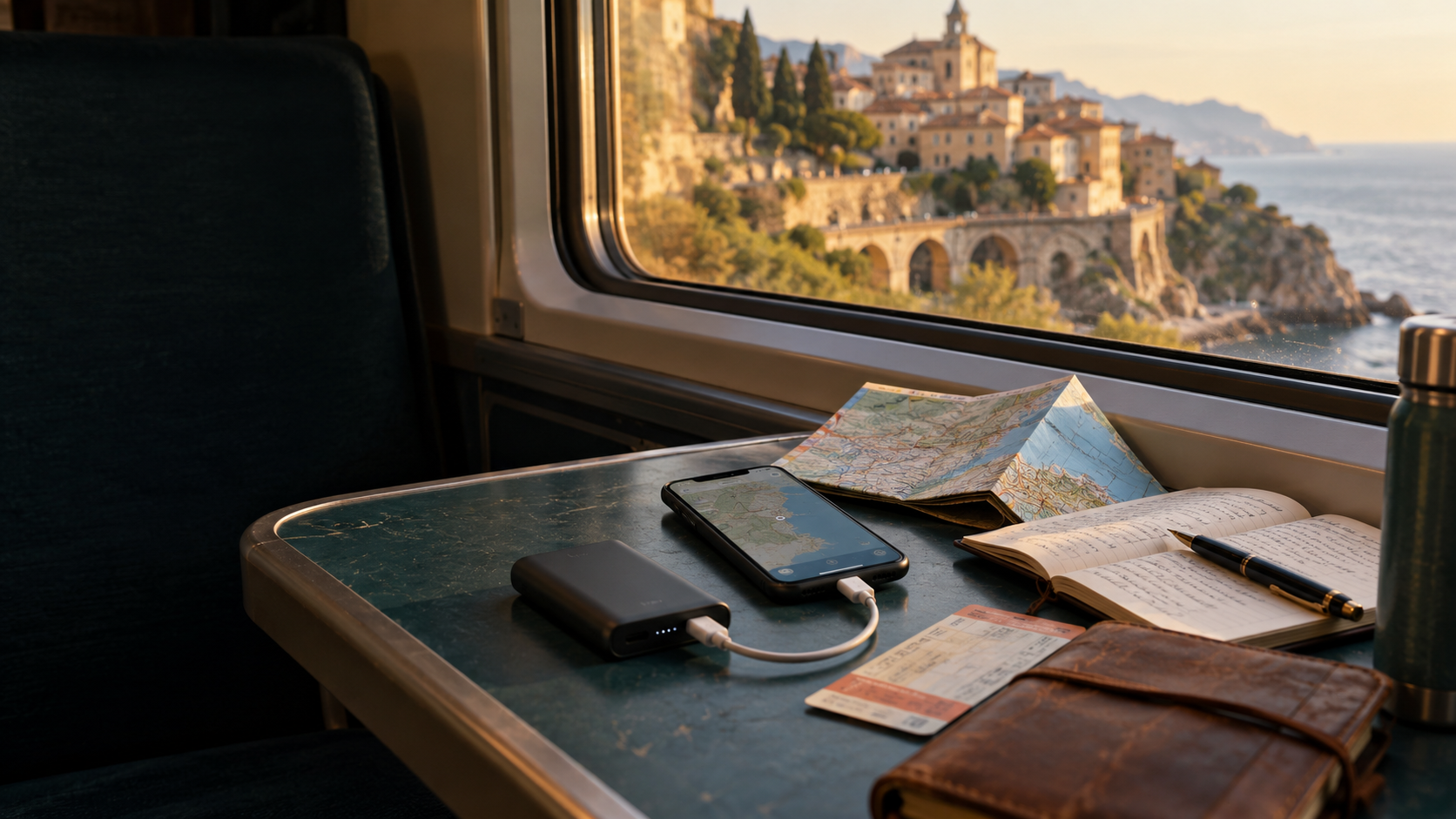
Bring a Portable Battery
Navigation eats battery. Taking pictures eats battery. Looking up train schedules eats battery.
Using your phone all day in a city you’ve never visited before really eats battery.
Your phone is your map, camera, translator, boarding pass, train ticket, wallet, and lifeline.
A small portable battery belongs in the backpack.
This is not where I choose to live dangerously.
Do this before you leave
The “I’d rather figure this shit out from my couch” checklist.
Check your current phone plan
Find out exactly what happens when your phone connects overseas. Included? Daily fee? Monthly add-on? Financial ruin?
Decide: carrier plan or eSIM
Do the math for the entire trip—not just one day.
Make sure your phone is unlocked
Especially if you’re planning to use an eSIM.
Install and set up your eSIM before you leave
You don’t necessarily have to turn it on yet. Just don’t make “figure out cellular technology” your first European activity.
Set up WhatsApp
And make sure the people you actually need to reach have it too.
Download offline maps
Do it while you’re sitting comfortably on your own Wi-Fi.
Download your translation language(s)
Naturally, the moment you desperately need Google Translate will be the moment you don’t have service.
Save your important travel stuff offline
Boarding passes. Train tickets. Hotel addresses. Reservations. Confirmation numbers. Screenshot the particularly important stuff.
Make sure somebody at home has your itinerary
They don’t need a minute-by-minute account. Just enough to know roughly where you’re supposed to be if something goes sideways.
Pack a portable battery AND the cable
Ask me why I’m specifically mentioning the cable.
Turn on Find My or device tracking
Losing your phone sucks. Losing it when your boarding pass, maps, credit cards, and entire known universe are stored inside it sucks considerably more.
Know how you’re contacting home
FaceTime? WhatsApp? Messenger? Carrier calls? Figure it out now and make sure it actually works.
Tell the assholes you love that you may not answer immediately
You are traveling. They’ll survive. Probably.
One More Thing: Put the Damn Phone Away
This may be the most important part.
Your phone makes international travel ridiculously easier than it was twenty years ago.
Use it.
Use maps. Translate the menu. Check the train platform. Take 700 pictures of a building because the light looks cool.
But occasionally?
Put the damn thing in your pocket.
Sit at the café. Watch people walk by. Get lost for five minutes. Look at the thing you traveled all this way to see with your actual eyeballs.
The assholes back home can wait.
You’re ready. Go see something.